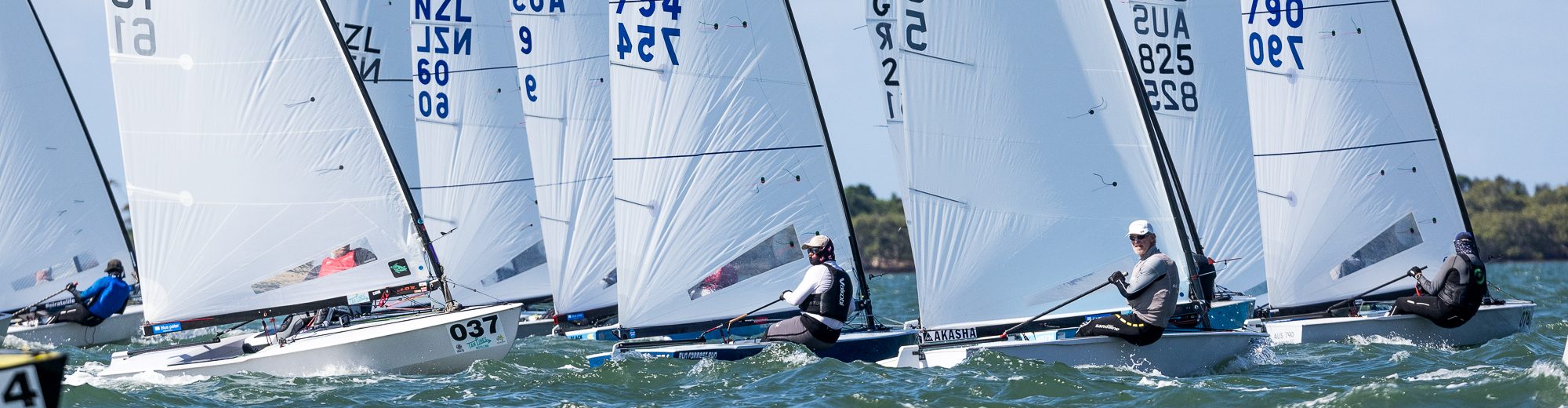

The 2026 World Championship in Denmark, brings the class full circle, 70 years after the first boat was launched by its designer Knud Olsen, in Bandholm in the south of the country.
Starting life in 1956, the OK Dinghy design was created in the hands of two Danes. One was a sailor seeking an exciting new concept in sailing and the other was an experienced designer and boatbuilder who knew how to put the concept onto paper. Together they built a legacy that was to become a central focus of many people’s lives for decades to come and continues to evoke enthusiasm and loyalty to this day. By their simple design, they have created a lasting family of sailors right across the world.
The following is extracted from the book, ‘Completely OK’ [Copies still available here – http://legacy.okdia.org/completelyok.php – and at Skovshoved]
————-
Various sources place the original conception of the OK Dinghy at various times, but most start in 1956 with Axel Damgaard Olsen in Denmark. A keen sailor, Axel Damgaard was the man responsible for introducing the Optimist Dinghy to Europe. He had gone to Clearwater, Florida in the USA in 1954 and saw an Optimist pram sailing in the harbour there. He quickly realised its potential, imported the plans back to Denmark and started a revolution in sailing.
Axel Damgaard’s other legacy was to provide the vision behind the design of the OK Dinghy. During the early 1950s in Denmark, there were only three main classes being sailed. The Pirat (a German design from the war, similar to a Snipe), the Snipe and the Finn. A large race would attract 20-30 Pirats and about 15-20 Snipes. Only a few dedicated helms sailed the Finn at that time.
A group of Pirat sailors under the leadership of Axel Damgaard realised the need for an inexpensive one-man planing, racing dinghy. The task to design the new dinghy was given to the boat designer Knud Olsen, who was asked to design a light one-man dinghy, that was cheap, could be amateur built and could be easily transported on top of a car. Axel also asked his good friend, the Finn sailor Paul Elvström, to design the rig and Paul suggested a flexible unstayed mast similar to that used on the Finn.
For the sail, the same mainsail that was used on the Pirat was chosen. The rest of the Pirat’s rig is very different, but the intention of using the same size mainsail was to save money for the potential sailors from the Pirat class. Many of the new helmsmen of the OK Dinghy would come from the Pirat class and therefore could in principle use their Pirat mainsails. However, the batten pockets on the Pirat were too short for the OK at 350mm and 500mm, so they were changed to 500mm and 700mm.
The first prototype was built during the summer of 1956 and trial sailed during late autumn of that year. It was suggested to name the boat using Knud Olsens’s intitials, the KO class, but as KO means ‘cow’ in Danish the two letters were reversed to OK. The first sail marks were simply an O and a K placed symmetrically beside each other.
During the winter of 1956 to 1957, around 70 plywood OK Dinghies were built. This initiative mainly occurred at progressive clubs, which often coordinated the building of boats as do-it-yourself projects during the winter. Four sailing clubs soon had active fleets racing: Helsingør, Copenhagen Amateur Club, Dragør and Hvidovre.
The first races for the OK Dinghy started during the 1957 season. Almost immediately, many helmsmen found they had trouble keeping their boats upright and in most of the races there were many capsizes. This was new to the Danish sailing world, as neither the Snipe nor the Pirat (which weighed over 200 kg) had the same problems. Taken in hindsight this seems rather odd, but one of the reasons for the many capsized boats was because the kicking strap was rarely used, even though some had learned from the Finn to use a wedge to hold the boom down.
There was also a problem with the rig. During the 1957 season more than half of a fleet still sailed with the Pirat axe symbol on the sail. With the Pirat being one of the most popular dinghies in Denmark, second-hand sails were readily available and therefore very cheap. Initially this seemed like an ideal solution, however it soon became clear that the Pirat mainsail was not really suitable for an OK Dinghy, as it was made for a stayed mast. Gradually a softer mast with the characteristic mast curve was developed, which could be used to flatten the sail and make it more controllable.
Also at that time the forward watertight compartment was formed by a bulkhead right behind the mast, so the area at the side of the centreboard case was not part of the buoyancy. Therefore it took some time to empty a capsized boat. Self-bailers did not exist either; they came to the class in 1958. The discussion in official race committees was whether the boat should be forbidden from racing.
Surprisingly, some clubs were actually in favour of this and did not allow OK Dinghies to participate in their regattas. With some of the most sceptical, or old-fashioned race officers this attitude remained unchanged for several years and was still around as late as 1960. Fortunately this exciting new dinghy also had a lot of support. People such as Paul Elvström gave the OK Dinghy a solid vote of confidence (even though he only raced an OK Dinghy on one occasion).
Due to the many capsizes and the reaction from the established racing community a new class was created in Denmark in the early 1960s. It was called OK-Junior, and was a complete copy of the normal design, but with only 6.5 sq metres of sail area. However, this specific version of the OK never really got any popularity in Denmark and it disappeared after a few years.
The first unofficial Danish championship was held in Hvidovre in September 1957. One non-Dane participated, Pierre Poullain from France, who was one of the best Finn sailors of the time. He was invited by Elvström, who also acted as chairman of the race committee for the event. Pierre finished second, only beaten by the Dane, Bjørn Eduard, who also took the first official championship two years later. There was no international participation in Danish championships over the next few years, although the Danes did participate in the Marstrand regatta in Sweden from 1962 onwards.
The driving force of the class in these early days was Axel Damgaard. His enthusiasm enabled the class to spread all over Denmark and then overseas. He carried his OK Dinghy on the roof of his car and took it to Oslo, Hamburg and other major yachting centres. When he moved to Seattle in the western USA in the late 1950s he took his enthusiasm with him and started the first fleets on the other side of the Atlantic.
Paul Elvström also played an important role, both making sails for the fledgling class and distributing the plans to countries such as France, where serious production began almost immediately, and also to Norway, Sweden, Germany and England.
Richard Creagh-Osborne, Great Britain’s 1956 Olympic Finn representative, was also at that first event in Denmark and was very enthusiastic about the class. He took the plans home to England and started to make rules and building specifications using his experience from the Finn class. He also used his connections from his publishing business to promote the class in the UK and worldwide with the intention of making it into an International Class.
The rapid development of the class clearly showed the Danish sailors’ desire for a cheap and fast sailing dinghy, and also proved that Denmark was a young and developing sailing nation. Most of the OK Dinghy sailors in Denmark at that time were previously Junior-boat helmsmen (a small Danish training keel boat) and so were really keel boat sailors and unused to balancing a dinghy. It took many capsizes before they learned how to properly handle a small sailing dinghy and this was part of the reason many clubs tried to ban the OK Dinghy as unsafe.
The rest, as they say, is history…